Приказивање постова са ознаком study. Прикажи све постове

8/10/2015

Making flashcards


   Making flashcards electronically is a much quicker process, and they’re much easier to transport (I can access them all on my phone). They’re also better for the environment. I use an app called Flashcards Deluxe (this app is paid, but there is also a free version available). The app lets you create your flashcards, add pictures and sounds, and even download flashcards from other flashcard sites like Quizlet (this is the site that I use to create the sites but then they’re all downloaded onto the app). It has a great feature which lets you download auditory files so your device will actually read out your questions and then read out your answers as well. There are also testing modes, so that you can be tested on multiple choice questions (using your answers for other cards) and you can be timed on your answers as well (a kind of quick fire round). Below is a screenshot from one of my cards about vision. 
If you don’t want to use flashcards on your phone, but you still want to make electronic cards, I highly recommend using Quizlet. It’s got a really simple interface, and several games that can test you on the cards.
     Physical flashcards are made on pieces of paper or card. You can buy packets of ready-made flashcards, with the biggest available packs holding 1000 flashcards, but you can also make your own by cutting/ripping your paper/card to the size that you want it.  I usually buy my packs of cards from Paperchase (this pack specifically) and organise them in a clear plastic container (available here). I have used paper cards before and found it was useful to keep them all together on a small metal ring. When doing this, it’s also useful to use a hole reinforcers to support the holes (you can buy them here).
       Write your questions on the card. As I wrote the questions, once a side of card was filled up, I went through the questions to make sure that I wasn’t getting ahead of myself and then made the next card. I also printed some pictures/diagrams onto the cards if I felt that they were relevant to the topics/questions I was testing myself on. Here’s a small guide to printing on flashcards. And there’s another guide here (by winterevezakire)
I also used page tabs to mark the cards. I think blue page tabs meant that I kind of understood that card, but not fully and red/pink meant that I was hopeless on that card and it really needed looking at. This really helped me focus my studying on what I was struggling with.
         You can write answers on the backs of your flashcards as well. I tended to only do this if it was an answer that I knew I was really going to need help with or if I had already struggled to answer that question (as marked by the red tabs). 
The actual questions that I wrote were based on my lectures/readings. I tried to cover every topic. If I was struggling with a topic then it would be broken down into a lot of questions and then as I got more familiar with it, the questions would become more general. So for example, I have specific questions like “what is behind the cornea?” but when I get more used to this topic the questions will become more general things like “describe the anatomy of the eye” so that I’m not relying on my question wording or anything to retrieve the answer.
           I would give a word of warning about flashcards though. While I advocate their use, they shouldn’t be used in isolation. I find that flashcards are a very static approach to revision, which allows you to remember things and get a foundation knowledge, but they don’t help you understand because they don’t ask you to apply the knowledge, or question it, or see links between topics. To do that, other forms of revision are needed as well. 
Here are some links to some of my favourite flashcard sets for inspiration:

Study SPace Guide

    Have a good desk. Find a desk or table with a top that rests somewhere between your waist and ribcage when you sit at it, so that your elbows can rest easily upon it without having to hunch your shoulders forward. You also want to be able to rest your feet flat on the ground. Use a comfortable chair that fits the height of the desk / table. You may want to skip the fancier desk chairs that rotate, roll, recline, lift, etc., if these will only become distractions. If you are using a computer, you want enough space to place it about 1 ½ to 2 ½ feet away from you.
    Kill distractions. Your phone, and TV are not your friends when it comes to studying. Don’t rely on willpower: put obstacles between yourself and the distractions.
Turn your phone off - or at least put it on silent and leave it across the room, where you can’t fiddle with it.
Use browser extensions like LeechBlock and Nanny to block distracting websites. Here’s a more extensive list of blocking extensions and apps (for phones, and laptops). Setting yourself regular breaks can help you avoid temptation during work time because you can use the time to check your phone.
    Tidy up. Clearing away the clutter from your study space should help clear your mind, allowing you to focus on the job at hand. You’ll also avoid losing important notes in piles of disorganized paperwork.
    Light it up. Ensure there’s good lighting in your study space. If it’s too dark to read, you won’t get very far. During the day, working by the window or even outside can give you the best light to work by. Remember that lamps can be bought for just a few pounds if you don’t want to use your light.
     Get settled… A comfortable chair will keep you working more effectively than an uncomfortable one. Avoid sofas, and your bed; those areas should be for relaxing alone or you might find it difficult to drift off at night.
…or get moving. Study doesn’t have to be still. If you are the sort of person who doesn’t like to sit still all the time, get on your feet and pace around while repeating what you’re studying aloud. I enjoy walking around my room, catching a ball while reciting facts, or talking through a theory.
     Find the right background noise. A little bit of backgrounrain noises, cafe sounds or white noise. There’s a list of music options and links here.
d noise can block out distractions and help you concentrate - but the wrong kind can be a distraction in itself. Instrumental music is generally considered the best choice, as lyrics tend to be more distracting. Alternatively, there are lots of websites and apps that play
     Be equipped. Make sure that you have all the books, resources and equipment needed to get the job done when you start - that way, you won’t be constantly stopping and starting to go and fetch things. Try to keep everything that you need within reach of your desk (e.g. a nearby drawer, pencil pots, boxes).
     Consider a clock. This depends on the type of person you are. Will a clock motivate you to keep studying for an hour more, or remind you that your favourite show is on in only 15 minutes.
  • Try using a clock to set time-related study goals. You can also use the clock or timer feature on your phone or a watch to help you do this.
  • You could also try out a timer for even more precise time-keeping, especially if you are preparing for a timed exam.
  • If the tick-tock of a clock bothers you, go digital, or get a sand timer.
     Shut out the outside world. The outside world is a dangerous place, full of noises and people coming to distract you. Shut the door to build yourself a private study cocoon. If anyone needs you, they can knock. If your family are distracting you, explain how important your studying is and ask that they respect that you need privacy.
    Get the temperature right. Try to get the temperature right in your study space. If it’s too hot or cold, you may not be at your most productive. It’s hard to write neatly when you’re shivering.
     Decorate to motivate. Adorning your study space with posters, signs, and photos that are important to you may help give you that boost to keep going. Just make sure they don’t become distractions.
  • Figure out what kind of motivation works for you. A picture of your family or a beloved pet? A poster of the car you hope to get after you pass these exams and graduate? Copies of your earlier exams in chemistry with poor scores that you are determined to improve upon? Determine whether you need more of a “push” or a “pull” to keep you motivated.
Don’t go overboard. Remember that the purpose of a study space is to help you study more effectively. If you spend too long trying to set up your space just so and end up significantly reducing your actual study time, you will be doing yourself a disservice. A study space meant to limit distractions can become a distraction itself.

8/08/2015

How I revise (for psychology A-level)

I am currently taking my psychology A2, having got an A in AS. I am aiming for an A* and having got that grade in my official mocks, I’ve been asked to make a post about how I study for this subject! Some of the information here is subject specific but most of it can be applied to other subjects).
I can’t say this post will be as pretty as some of the other posts I see in the studyblr community, but I’ll do my best to be helpful…
Tip 1- Make detailed notes that make sense to you
Remember that your notes do not need to act as a textbook. They are there to help you understand everything. I think that in the studyblr community, it sometimes feels that notes need to be neatly written and completely coherent to other people. They don’t. If that is the form of note-taking that works for you, then that’s great. But understanding the concepts, studies and research methods has to be the priority: YOU DO NOT NEED TO MEMORISE ANYTHING AT THIS STAGE. That’s a job for after class…
Tip 2- Make your revision materials as soon after class as possible
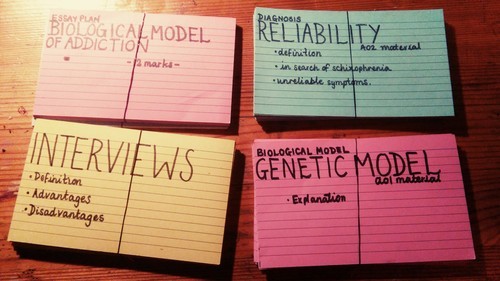
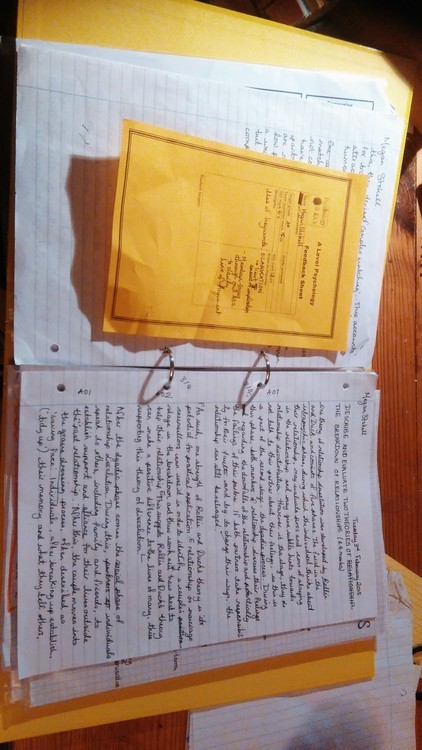
This is a lesson I learned the hard way in AS. I didn’t make my revision materials as I went along and by the time it got to April, I was panicking. After a lesson, I like to make colour-coded flashcards to record the important information and studies.
As soon as I’ve learned all of the information required for an essay, I like to make flashcards summarising each of the paragraphs. I try to use as few words as possible- I like to keep these in my visual memory so that I can spend as little time planning as possible in the exam itself.
Also- smell code your flashcards. Scent is the most evocative sense, so make the most of it! I use a different scent for each exam and then wear that scent on the day of the exam. Just do it. Trust me.
Once you have made the flashcards, remember to use them!
Tip 3- Read around the subject while you have time
Of course, this helps a lot to just gain a general understanding. I understand that once school is going on, it can be difficult to find the time for these things. So this is a job for weekends or the holidays so far as I’m concerned. Borrow books from libraries or friends. Buy them second-hand at justbooks., or just new if you have the money for that sort of things (unfortunately I do not). Also, I find that psychologytoday is an excellent resource for reading around the subject online. 
Even if you read about things that aren’t strictly relevant to your exam topics, it’s an excellent way to gain understanding of the way that psychologists write, think and investigate new theories. It also wins you brownie points with your teachers. 
Equally, I would recommend the magazine ‘Psychology review’, especially if you are studying with the exam board AQA, because it contains lots of relevant information for this specification.
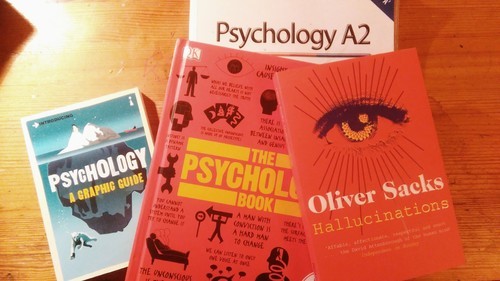
Pictured are a few of my favourite psychology-related books (plus my textbook). I also love love love the book ‘What is madness’ by Darian Leader, (not pictured because I recently lent it to a friend) which is great for the AS topic of ‘abnormality’ and any of the mental disorders discussed at A2.
~side note, ‘What is Madness’ is also interesting if you’re studying ‘psychology of religion’ as a module in philosophy and ethics~
Tip 4- Surround yourself with the knowledge you want to absorb
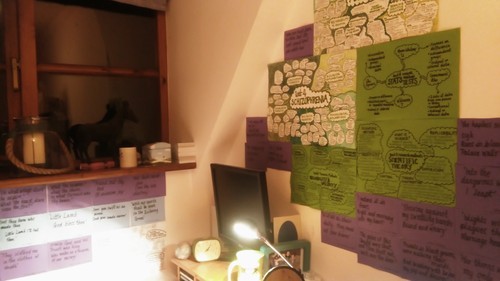
Of course- like most of my tips, this is geared towards visual learners. I am a big believer in revision posters. It turns my room into a positive studying environment, adds colour to my walls and really helps to keep me motivated! It also does wonders for my recall because I can visualise my walls if I’m ever stuck.
This is my study corner at the moment (featuring quotes I need to know for English and poor lighting). I haven’t finished learning all of the material for this year yet but I am sure my study corner will expand before my exams in June…
Tip 5- Make the most of what is available to you
I don’t know what the psychology departments are like elsewhere, but the teachers at my school are great. They make booklets summarising information from each of our modules and these act as alternative revision guides (which is especially great when I can’t deal with lugging my massive text book around all day).
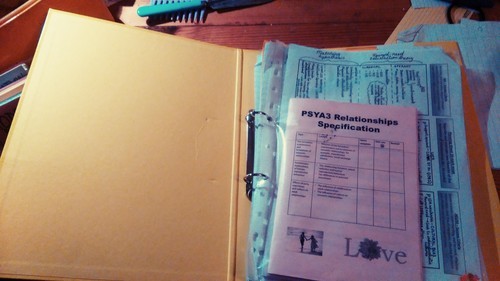
Print out and colour code the specification if you can- know your strengths, weaknesses and the mark scheme (these will be available on the website of your exam board). It’s also a good idea to have a look at the examiner’s reports for each year and use other available information such as…
Tip 6- Doing past papers under timed conditions
This tip is fairly self explanatory. Do the essays under the time stress. Practice your balancing of analysis and evaluation, practice remembering your essay plans without any prompts. 
If you can get your teacher to mark them, that’s awesome, but if not, call up the mark scheme and assess yourself. Work out your strengths, the areas you need to improve and then formulate some measurable and attainable targets. 
Bonus tip: do not go overboard on this one. I did this as AS and got repetitive strain injury in my wrist from writing too much. I then had to do all of my AS exams on a laptop in a room alone, which I hated.
Tip 7- Before the exam…
Teach your material to other people. I am blessed to have a very patient mum and we take the dog out for ‘revision walks’. I like to do this the evening before an exam because it reassures me that I know the material, whilst making sure I get out of the house and do not spend too much time alone with my own anxiety.
Relax. Face masks, hair masks, skype a friend, whatever you need. (Fun fact: my mum went to university at Cambridge and had a tutor that would send her and others on her course out punting the day before a big exam. He said that any cramming would be detrimental at this stage and I’m inclined to agree.)
On the day, read your posters or any condensed notes you may have. Don’t go with the flashcards right before the exam- if you have a mind-block, this can definitely send you into a panicky downward spiral before you go in.

Good luck lovelies!

BY : studyingwithfarydust on Tumblr

How to study like a straight A student


1. Sit in the front row.

This isn’t high school anymore, it’s not embarrassing or nerdy to sit in the front row. By sitting in the front row, you won’t be tempted to check your phone and you won’t be distracted by looking at the people around you. I focus best in the front row. This also gives you a chance to easily ask any questions you have.

2. Show up to class a little early.

Show up to class about five minutes early every day, if possible. During the time it takes your professor to get set up, read through your previous notes. If you do this every day, you’ll begin to memorize info that you certainly wouldn’t have learned if you spent those five minutes before class just scrolling through tumblr. 

3. Type your notes and print them out.

If you prefer to spend a lot of time on hand written notes, then go crazy. However, I don’t really have time to make aesthetic notes, so I prefer to just write my notes by hand during class, then copy them into microsoft word so I can organize and print them out. This makes the notes much easier to read, and it’s much easier on the eyes. 

4. Do every assignment. Yes, EVERY assignment.

I don’t know why there’s advice floating around on tumblr telling people that it’s okay to skip a ton of homework assignments, because I definitely wouldn’t recommend it at all. Of course some assignments might be stupid or seem too small to matter, but if you’re being graded on them, you need all the points you can get. Trust me, just because homework assignments only account for 10-15% of your final grade, that doesn’t mean that they won’t be the difference between a B+ and an A-. Think about it: if your homework is 10% of your grade and you didn’t do it, you would literally have to get NOTHING wrong on your exams just to get the lowest A- possible. 

5. Don’t skip. Don’t skip. Don’t skip. 

Don’t skip if you can help it. If there is a serious emergency and you really can’t make it, try your hardest to get the best notes you can from someone who was in class. There’s nothing worse than sitting down for a test and realizing that a ton of the questions are about content you missed when you were absent. 

6. Go over material in your head when you’re not busy. 

If you’re in the shower or waiting in line at the cafe, go over class material in your head. Think about what you learned that day. If you do this often, this will help significantly with retention. 

7. Make flashcards throughout the semester, not the night before the final.

Don’t be one of those students who has to relearn an entire textbook the week before finals. If you’re studying right, studying for finals should be relatively painless. Throughout the semester, make flashcards of class content and regularly go over them. The easiest way to do this is to use quizlet.com and fill in definitions and other things you need to know, and use their helpful games and quizzes to memorize the info. It even keeps track of the definitions you rarely get wrong, so you know what you don’t need to study as much. 


8. Makes specific agendas for what you need to study and get done. 

When I study, I need to have a very specific to-do list detailing exactly what I want to get done. This will motivate you to keep going because you’re able to check off what you’ve already done. 

9. Don’t get discouraged by a bad grade- take it as motivation.

This is much easier said than done, but I had to do this in my western civilization class when I very nearly failed the first set of exams. If this happens to you, you should definitely take time to be upset about the grade, but don’t let yourself think it’s the end of the world. If you do badly, at least you know what to expect on the next assignment/exam so you know how to alter your studying to prepare for the next one. You can do it! I started western civ with a high D+ after my first exams, but I pulled out with an A- at the end of the semester! 


BY:  collegerefs on Tumblr 

STUDY TIPS: How to get A's

MY STUDY TIPS


1. Be consistent

if you want to achieve results in anything then you should dedicate yourself to what you want to do. Don’t think that you can study for a few hours today and then do nothing until the next week. Nope, that’s not how it works. You will benefit even from 15-20 minutes a day
2. Plan your time
That really does help you! If you have a planner. Write down the time you should spend studying science or maths, for example. Like 20 mins- science//15 mins-maths. And just do it. Simple as that. Or you can print the schedule and pin it on your wall/put on your desk. That will be helpful too. Just search for “weekly planner printable” on Pinterest. I’m sure you’ll find the ones you may like.
3. Make it fun
Everything is better when it’s fun, rught? So make your study place colourful (if you like that, obviously), get some stationery, DIY some stuff and just enjoy the process. I can also suggest playing some relaxing music but it should not distract you. There are lots of good mixes on 8tracks.
4. Take breaks
You’re a human, not a zombie! Studying might be cool and that process when you feel you brain enriching with information is also fantastic (i’m not kidding) but when it gets too much you need to take a rest! You can take breaks every 20/30 mins if you feel comfortable with that. 
5. Have a snack
I’m all for vegan treats and they are waaay bettern than saturated fatty sweets so….I’d say make yourself a nana icecream or a smoothie bowl. You can also have a fruit plate and nuts, whatever you prefer.
6. Discover new ways of studying
Do you actually know that studying dies not only exist within your books? You can find sth useful everywhere-even on tumblr! Tumblr is an endless source of information and inspiration. Find quotes for your essays, opinions of different people on various problems. I track the tags “politics”, “economy”, etc. and they do give a great spectrum of information. Watch documentaries, read books, blogs, anything! There are tons of things to do. You can even take a course on Coursera which offers free lectures/material/tasks/assignments. After completing the course you’ll get a certificate which may be very handy one day.
7. Play cards
nope, I don’t mean playing actual cards. I suggest making your own! Take a sheet of paper, cut it into 8/10/15 parts and write 1 question on one side and the answer on the other. lay down the cards and make the fun start. It’s a lot better when you can play with someone so call your squad and study together!
8. Keep notebooks and journals
They will show your progress. Write down what you’ve done, new words (if you’re studying a new language), sth which was important to you, sth that surprised you…
9. Don’t get distracted
Switch off your phone. Yes, I know how sometimes it’s much more interesting to spend time on social media or just surfng the internet. But remember your goals! Visualize them! You can achieve academic success and that’s not that difficult!
10. Revise
Our memmory is constructed in a certain way that if we learn new information we need to revise it in 5 minutes,  in 30 mins, in 1 hour, in 5 hours, in 1 day, etc… and also having a look at your notes before going to bed may help you too. Engage all types of memmory and draw, read aloud, write down all the stuff you need! I promise you’ll succeed.
11. Question everything 
No matter what subject it is you should be critical. Learn to question everything you see. If it’s a picture/cycle find out who is the sender of the message, are you the one that should get this message, what did the creator of the pic want to say? If it’s a text then get the basic idea and be sceptic about what you read, Question yourself and try to find the answers.
And the last, most important thing is to see your goals. If you don’t have any, you won’t progress. It’s important to know why you’re studying this, be interested in what you’re studyingand be willing to develop and learn more every day!
Hope this helps!

BY : style-frappuccino on Tumblr